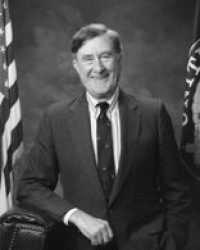
John Chafee
Session Voting Records
106th Congress
Validating Roe v. Wade
Nuclear Test Ban Treaty
Agricultural Appropriations
Labor/HHS/Education Funding
More Money for Federal Day Care
After-School Child Care
Nationalizing Education
Republican Tax Cut Package
Republican Tax Cut Package. This legislation is identical that described in House Vote (below).
[ House - Republican Tax Cut Package. The Republican tax plan would implement several tax cuts over a 10-year period. The legislation would cut the income tax rate by one percent beginning in 2005, but the tax cut would sunset by 2009. The measure would also cut the capital gains rate immediately by two percentage points, eliminate the marriage penalty under income taxes (starting in 2001), and phase out estate taxes until 2009 (after which the tax would be higher than current law).
The Republican Party trumpeted this bill as being a $792 billion tax cut, and the White House lobbied furiously against it claiming that the cuts were irresponsible. But the $792 billion figure is mere political posturing, since it is not only the projected total for a 10-year period but is based on projected costs in future years. Nevertheless, the bill was better than no tax cut at all and was deserving of support. ]
The measure, the final version of H.R. 2488, was adopted by the Senate on August 5, 1999 by a vote of 50-49 (Roll Call 261). We have assigned pluses to the yeas.
National Endowment for the Arts
Holbrooke Nomination
Eliminate Sugar Subsidy
Eliminate Sugar Subsidy. This amendment would eliminate the federal sugar subsidy program, which creates import quotas, price supports, and loans to growers. Noting that the cost of this program to consumers is $1.4 billion in higher prices and higher taxes, Senator Judd Gregg (R-NH) explained that "the sugar program stifles competition. Seventeen growers get 38 percent of the benefit of this program...."
The measure, an amendment to S. 1233, was tabled (killed) by the Senate on August 4, 1999 by a vote of 66-33 (Roll Call 254). We have assigned pluses to the nays.
Minimum Wage Increase
Minimum Wage Increase. A proposal by Senator Edward Kennedy (D-MA) would increase the national minimum wage by one dollar, from $5.15 per hour to $6.15 per hour. Senator Don Nickles (R-OK) opposed the amendment, observing that "we should not be passing a law in a tax cut bill to say it is against the law anywhere in the country to work for $6.10 an hour, that the federal government, in its infinite wisdom, decided if you don't have a job that pays at least $6.15 an hour you should be unemployed."
Sen. Kennedy's measure, an amendment to S. 1429, was rejected by the Senate on July 30, 1999 by a vote of 46-54 (Roll Call 239). We have assigned pluses to the nays.
More Federal Education Spending
More Federal Education Spending. This amendment would simply express the "sense of the Senate" that $132 million of the proposed 10-year tax cut should be shifted to wasteful federal education programs. The proposal untruthfully states that the tax cut it would abolish, a one percent reduction in the rate of the lowest income tax bracket, would "disproportionately benefit upper income taxpayers." Senator Tim Hutchinson (R-AR) argued against the amendment, noting that "If we do not pass the $792 billion tax relief, that money will not go toward paying down the national debt. It will, as already suggested in the speeches on the other side in the last few minutes, immediately go into more spending."
The Senate killed the measure, an amendment to S. 1429, defeating by a 48-52 vote on July 30, 1999 a waiver of a Budget Act point of order against the measure (Roll Call 232). We have assigned pluses to the nays.
Subsidized Trade with Vietnam
Subsidized Trade with Vietnam. "Vietnam has historically not been eligible to take advantage of American taxpayer-funded programs which subsidize business deals between American companies and the Communist Government agencies in Hanoi," explained Senator Robert Smith (R-NH). "That is, until last year."
In 1998 President Clinton issued a waiver of the Jackson-Vanik law for Communist Vietnam, giving a green light to federal corporate subsidy programs beneficial to the Red regime. Sen. Smith's legislation would overturn Clinton's waiver and ban taxpayer subsidies from going to the butchers in Hanoi through programs such as the Overseas Private Investment Corporation, Export-Import Bank, and U.S. Department of Agriculture subsidy programs.
A discharge motion on Sen. Smith's bill (S. J. Res 28) would have brought the measure from the Finance Committee to the floor for a vote on passage. The Senate rejected the motion on July 20, 1999 by a vote of 5-94 (Roll Call 214). We have assigned pluses to the yeas.
MFN/NTR Trade with Red China
MFN/NTR Trade with Red China. This legislation is identical to the House Vote in that it would reverse President Clinton's decision to grant China "Normal Trade Relations" (formerly Most Favored Nation status). But the Senate dispensed with the measure in a different manner, voting on whether to discharge the resolution from the Senate Finance Committee for a vote on passage instead of voting on the resolution itself.
The Senate rejected the discharge motion on the bill, S.J. Res. 27, on July 20, 1999, by a vote of 12-87 (Roll Call 213). We have assigned pluses to the yeas.
Subsidizing Abortions
Subsidizing Abortions. This measure, an amendment to ban federal financing of employee abortions, is identical to House Vote (below). It was adopted by voice vote after a tabling motion failed.
[ House - Subsidizing Abortions. Representative Rosa DeLauro (D-CT) proposed a measure that would allow abortions to be included as medical expenses in the health care coverage the federal government subsidizes for its employees. Representative Curt Weldon (R-PA), opposing DeLauro's proposal, explained that "the unborn baby in the womb is not a potential life. It meets all of the criteria of a life, the criteria that I used to use as a practicing physician to determine whether somebody is alive or dead: a beating heart, active brain waves." ]
The tabling (killing) motion on the measure, an amendment to S. 1282, was rejected by the Senate on July 1, 1999 by a vote of 47-51 (Roll Call 197). We have assigned pluses to the nays.
Foreign Aid Appropriations
Foreign Aid Appropriations. This $12.7 billion foreign aid appropriations bill is similar to House Vote (below).
[ House - Foreign Aid Appropriations. This legislation would appropriate $12.7 billion during fiscal 2000 for wasteful and unconstitutional foreign aid programs abroad. ]
This bill, S. 1234, was adopted by the Senate on June 30, 1999 by a vote of 97-2 (Roll Call 192). We have assigned pluses to the nays.
End Aggression Against Yugoslavia
End Aggression Against Yugoslavia. Senator Robert Smith (R-NH) proposed a measure to prohibit military aggression by the U.S. government against Yugoslavia after October 1, 1999. Unlike Senator Specter's amendment (below), this measure would require an end to the air war as well. Sen. Smith noted: "Every single person out there who has a son or daughter old enough to serve in the military should ask themselves: Is it worth my son's or daughter's life to die in Yugoslavia for a humanitarian crisis that does not involve the national security of the United States?"
[ Specter's amendment - Combat Troops to Yugoslavia. A proposal by Senator Arlen Specter (R-PA) would prohibit any funds in the Defense Department authorization bill from being used to introduce combat troops into Yugoslavia, including Kosovo. The measure would exempt "peacekeeping" police forces from the prohibition, and would therefore act mainly as a prohibition against a military invasion. Sen. Specter explained that the measure "is designed to uphold the Constitution of the United States, which grants the exclusive authority to declare war to the Congress of the United States." ]
Senator Smith's proposal, an amendment to S. 1059, was tabled (killed) by the Senate on May 26, 1999 by a vote of 77-21 (Roll Call 151). We have assigned pluses to the nays.
Combat Troops to Yugoslavia
Combat Troops to Yugoslavia. A proposal by Senator Arlen Specter (R-PA) would prohibit any funds in the Defense Department authorization bill from being used to introduce combat troops into Yugoslavia, including Kosovo. The measure would exempt "peacekeeping" police forces from the prohibition, and would therefore act mainly as a prohibition against a military invasion. Sen. Specter explained that the measure "is designed to uphold the Constitution of the United States, which grants the exclusive authority to declare war to the Congress of the United States."
Senator Specter's proposal, an amendment to S. 1059, was tabled (killed) by the Senate on May 25, 1999 by a vote of 52-48 (Roll Call 145). We have assigned pluses to the nays.
Contact information not available for this legislator.
Create a free account to save legislators to lists and create custom scorecards.
Create Free Account Log inAlready have a Freedom Index/JBS account?
You may add contact information to Scorecards, print and share them.
Do not make unauthorized changes to the Scorecards.
Leave unchecked for no personalization.
Save your contact info to a free account to reuse it on other legislator scorecards.
Save Your Contact Information for Next Time
Create a free account or log in to save multiple contacts for future use.
Search Results

Get the FreedomIndex.us App
Install for faster access, or learn how this app experience works.